
Jason Scott Ellis was born on September 22nd, 1979. At the time of his death, he was thirty-three years old and had served with the Bardstown Police Department for approximately seven years.
Bardstown, located about forty miles southeast of Louisville, Kentucky, is a community best known for its historic downtown, bourbon distilleries, and small-town atmosphere. Although the surrounding countryside can appear peaceful, Jason’s work exposed him to the same criminal activity that police officers encounter in larger cities.
He joined the Bardstown Police Department in 2006 and developed a reputation as a productive, dedicated officer. In 2008, he was named the department’s Officer of the Year.
That same year, he became the department’s K-9 officer, working with a German shepherd named Figo. Together, Jason and Figo were involved in narcotics enforcement and other police duties. Jason was the department’s only K-9 handler at the time of his death.
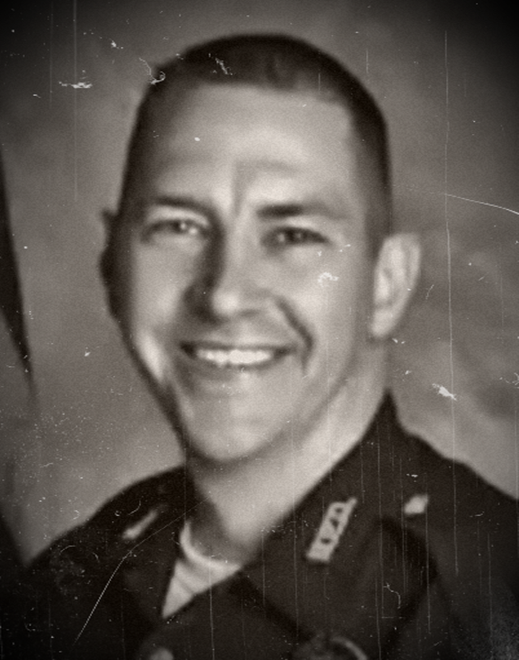
His supervisors later described him as particularly effective in investigating drug-related offenses. He was considered one of the department’s leading officers in making arrests, a distinction that would eventually become relevant to some of the theories surrounding his murder.
Before becoming a police officer, Jason had pursued baseball, playing professionally in the Cincinnati Reds’ minor-league system. Although his professional baseball career ended, his enthusiasm for the sport continued, and he became involved in coaching youth baseball. On the evening before his murder, he had reportedly spent time coaching his son’s baseball team.
At home, Jason was a husband and father. His wife, Amy, and their two boys, Hunter and Parker, were waiting for him to return from work that Saturday morning. The children were just seven and six years old. By all accounts, Jason was devoted to his family, and he had an active role in his children’s lives.
Friday, May 24th, 2013, passed without any public indication of the tragedy that would unfold. Jason was working a late shift with the Bardstown Police Department. According to accounts of his final hours, he handled an arrest late in the evening and transported the individual to the local jail.
Shortly before two a.m. on Saturday, May 25th, Ellis signed off duty over the police radio. He was heading home to Bloomfield, a small community northeast of Bardstown.
Although his regular duties included working with Figo, the dog was not accompanying him that night. Jason was driving a marked police cruiser rather than his usual K-9 vehicle. The car also lacked a dashboard camera that might have recorded his final encounter.
His route home took him along the Bluegrass Parkway, a limited-access highway running through central Kentucky. Sometime around two thirty a.m., Ellis approached Exit 34, where he intended to leave the parkway.
There, he encountered the tree limbs blocking the ramp. The obstruction was large enough to demand attention. Rather than simply navigating around it, Jason stopped to clear the roadway. He turned on his cruiser’s emergency lights and positioned the vehicle to alert oncoming traffic. Then he got out.
What happened in the following moments was reconstructed from physical evidence and the condition of the crime scene. There were no publicly identified eyewitnesses to the actual shooting.
The killer had apparently selected a location that offered a distinct tactical advantage. The exit ramp ran below a wooded embankment, providing a concealed position overlooking the roadway. Anyone standing on the higher ground would have been able to see a person stopped below while remaining difficult to spot in the darkness. Investigators determined that the gunfire came from an elevated position beside the ramp.
As Jason was removing the branches, the shooter fired multiple times with a 12-gauge shotgun. The officer was wearing his protective vest, but the shotgun blasts struck areas of his body that were not fully protected, including his extremities and head. The injuries were devastating.
At approximately two thirty-six a.m., motorists approaching the exit noticed the stationary police car and its flashing lights. A woman driving a Toyota Corolla stopped near the cruiser. Another motorist, identified in reporting as Chad Monroe, subsequently arrived and approached the scene.
Initially, it was not immediately apparent what had happened. Monroe noticed the officer on the pavement and realized something was terribly wrong. Blood was visible around Jason, who was unresponsive.
The woman used the patrol car’s radio to summon assistance, while authorities were initially given information suggesting that an officer might have been struck by a vehicle. According to the Officer Down Memorial Page, a citizen’s emergency call was recorded at two fifty-three a.m.
When a Kentucky State Police trooper arrived, however, the injuries and other evidence quickly established that the officer had not been involved in an ordinary traffic accident. He had been shot. Jason Ellis was pronounced dead at the scene.
There was no indication that Jason had been responding to a call for service or conducting an ordinary traffic stop. He had not radioed dispatch to report that he was investigating a suspicious person. His service weapon was still in its holster, suggesting that he never had an opportunity to respond to the attack.
Instead, the available evidence suggested that he had walked into a trap. The debris in the roadway had placed him in a vulnerable position, while the shooter used the surrounding terrain and darkness to remain concealed. The attack was over before anyone else arrived.
The discovery sent shock waves through local law enforcement. Bardstown had lost a police officer in the line of duty, something the department had never experienced before.
Kentucky State Police assumed responsibility for investigating the homicide, with assistance from other law enforcement agencies.
From the beginning, investigators were struck by the circumstances of the murder. This was not a confrontation that had unexpectedly escalated into violence. There had been no reported argument, no apparent struggle, and no indication that Jason had drawn his weapon. The obstruction, the elevated firing position, and the timing of the shooting all suggested preparation.
At a press conference on May 26th, Kentucky State Police Master Trooper Norman Chaffins described the killing as a deliberate, premeditated act. Investigators believed the tree limbs had been intentionally placed across the ramp to force a driver to stop. That person would then have to leave the relative protection of the vehicle to move the obstruction. The shooter’s position on the embankment also offered concealment and a downward angle of fire.
But one of the investigation’s most important questions remained unresolved. Had the killer specifically intended to murder Jason Ellis, or was the trap meant for another police officer, or even an unsuspecting motorist?
Chaffins acknowledged that investigators could not initially establish who the intended target had been. Police Chief Rick McCubbin, however, became convinced that Ellis had been deliberately targeted. The attack appeared far too organized to him to have been a random act of violence.
The question carried enormous implications. If Jason had been selected personally, the motive might be found in his police work, professional relationships, or interactions with individuals he had arrested. If the intended victim had simply been any police officer who stopped on the ramp, the possible suspect pool would be substantially different.
The investigation into Jason Ellis’s murder began immediately, with Kentucky State Police leading the effort and federal authorities providing assistance.
One of the earliest and most important pieces of evidence was the pile of tree limbs. Police determined that the branches did not appear to have originated from the immediate area surrounding the exit ramp. That discovery suggested that someone might have collected them elsewhere and transported them to the location.
On June 4th, 2013, Kentucky State Police publicly asked residents of Nelson County and surrounding areas to report any recent tree trimming or landscaping work. If investigators could establish where the branches had come from, they might be able to trace them to a particular property, vehicle, or individual.
The detail was unusual, but potentially significant. Unlike the shotgun, which might have been concealed or destroyed, the branches represented physical evidence that had to have originated somewhere. Police Chief Rick McCubbin acknowledged that tracing their origin was a major focus of the investigation.
Authorities also examined Jason Ellis’s activities in the days and weeks before his death, including his arrests and interactions with criminal suspects. One possibility was that someone Jason had arrested wanted revenge. Another was that his work with the department’s narcotics unit had brought him into conflict with individuals involved in drug trafficking.
Investigators also had to consider whether the killer possessed knowledge of Jason’s schedule and usual route home. That possibility was particularly troubling. If the gunman had selected Jason personally, the murderer might have known when the officer would finish work and where he was likely to travel. However, the public evidence did not establish that the shooter had inside information or that Jason’s movements were being monitored.
Hundreds of tips were received, and authorities pursued numerous leads. Reward money increased as businesses, residents, and local organizations contributed to the effort. By June 2013, the reward fund had exceeded $125,000, and it continued to grow. By 2023, reporting placed the combined reward offers at more than $200,000. Yet the identity of the murderer remained unknown.
In the weeks following the murder, the Bardstown Police Department received additional threats that heightened fears among officers and residents. One arrived in the form of a written message warning that more officers would be killed. Chief McCubbin reported the threatening communication to Kentucky State Police and the FBI.
The department also received information about a separate verbal threat suggesting that additional attacks might occur. In response to the heightened danger, Bardstown police began handling calls with officers working in pairs.
The threats raised the possibility that Jason Ellis’s murder might have been part of a broader campaign of intimidation or retaliation against law enforcement.
One of the more unusual developments in the case emerged years later through the Oxygen television series The Disappearance of Crystal Rogers, which examined several mysterious deaths and disappearances around Bardstown.
During the program, an anonymous prison inmate claimed to possess information about Ellis’s murder. According to the inmate, the officer had been investigating a series of storage-unit and commercial burglaries occurring around Bardstown in 2012.
The inmate alleged that Jason Ellis had gotten close to identifying individuals responsible for those crimes, prompting them to arrange his murder. He also claimed that three men had planned the killing in his basement.
Perhaps most significantly, the inmate claimed to know what had happened to the murder weapon. According to his account, the shotgun had been destroyed using a cutting torch and a vise. The inmate claimed to still possess the tools involved.
The allegations presented a possible motive: Jason may have been killed to prevent him from exposing a criminal operation. However, the claims were never publicly substantiated by law enforcement, and there is no verified evidence establishing that the alleged burglary ring was responsible for Jason Ellis’s death.
The inmate’s statements also involved claims about other Bardstown crimes, making it difficult to determine whether he possessed genuine inside knowledge or was repeating rumors.
Jason Ellis’s murder became even more unsettling as additional violent crimes occurred in and around Bardstown over the following years. Some of those crimes bore similarities to his killing, while others appeared quite different. Together, they contributed to the city’s growing reputation as the setting for a series of mysterious deaths.
On April 22nd, 2014, less than a year after Jason’s murder, for example, forty-eight-year-old Kathy Netherland and her sixteen-year-old daughter, Samantha, were discovered murdered inside their home in Botland, near Bardstown. Kathy was a special education teacher, while Samantha was a high school student. The women had been violently attacked in their home, and investigators struggled to determine who was responsible.
The double homicide attracted considerable local attention and eventually became associated in public discussion with the Jason Ellis case. However, investigators have not established a connection between the murders. The Netherland killings remain unsolved.
Then, on July 3rd, 2015, thirty-five-year-old Crystal Rogers, a mother of five, disappeared from Bardstown. Her vehicle was discovered abandoned along the Bluegrass Parkway, with personal belongings left inside. Her disappearance eventually developed into one of Kentucky’s most heavily publicized criminal investigations.
Rogers’s boyfriend, Brooks Houck, became the principal suspect. His brother, Nick Houck, was a Bardstown police officer who had served in the same department as Jason Ellis.
Nick Houck was fired from the department in 2015 after authorities determined that he had interfered with the Rogers investigation. That connection inevitably fueled speculation about whether the Rogers case and Jason Ellis’s murder could be related.
In July 2025, Brooks Houck was convicted of murdering Crystal Rogers and tampering with physical evidence. Steven Lawson and Joseph Lawson were also convicted of offenses connected to the Rogers case.
In June 2026, Nick Houck was arrested and charged with first-degree perjury in connection with testimony or proceedings between 2015 and 2023. The perjury charge was not a charge of involvement in Jason Ellis’s murder.
Despite the convictions in the Rogers case and the additional attention directed toward the Houck family, no public evidence has established that Brooks Houck, Nick Houck, or anyone convicted in the Rogers case was responsible for killing Jason Ellis. The fact that Nick Houck and Jason Ellis worked for the same police department is a documented connection, but it does not establish criminal involvement.
The next tragedy occurred on November 19th, 2016. Tommy Ballard, Crystal Rogers’s father, had devoted much of his life to searching for his missing daughter. Ballard was preparing to go hunting with his young grandson on family property near the Bluegrass Parkway when an unknown shooter fired a single shot, striking him in the chest. He died almost immediately.
The circumstances of Ballard’s murder prompted comparisons with the killing of Jason Ellis. Both men were shot in outdoor locations where the killer apparently had an opportunity to fire from a concealed position. Both crimes occurred in Nelson County, and neither shooter was apprehended.
Ballard’s family believed his death might have been connected to his efforts to investigate his daughter’s disappearance. Unlike Jason Ellis, though, Ballard was killed with a rifle rather than a shotgun. The murder remains unsolved, and the FBI continues to seek information about the identity of his killer.
The possibility that some of Bardstown’s notorious crimes were connected became a persistent topic of speculation. Some residents questioned whether a group of criminals had been responsible for multiple murders, perhaps eliminating individuals who threatened to expose their activities. Others wondered whether corruption or criminal connections within local institutions might explain why several high-profile cases remained unresolved.
Those suggestions have circulated in news coverage, documentaries, and online discussions, but many go beyond what investigators have publicly established. There are reasons to examine potential connections between the crimes, particularly given the geographic proximity, overlapping individuals, and apparent targeting in some cases.
But there are also significant differences. Jason Ellis was killed in an ambush involving a roadway obstruction and a shotgun. Kathy and Samantha Netherland were murdered inside their home. Crystal Rogers disappeared under circumstances involving people close to her, and her case ultimately resulted in convictions. Tommy Ballard was killed by a single rifle shot while preparing for a hunting trip.
In January 2023, Kentucky Attorney General Daniel Cameron appointed Commonwealth’s Attorney Shane Young as special prosecutor to evaluate potential charges involving the cases of Ellis, Rogers, and Ballard. That decision brought several investigations under a common prosecutorial framework, but it did not constitute a determination that the murders were connected.
In December 2023, state and federal investigators searched a property near Thompson Hill Road in Nelson County. Prosecutor Young confirmed that the search related to one of the three cases but did not publicly identify which. The search produced renewed interest in the investigations, although authorities did not immediately disclose what, if anything, had been recovered.
The subsequent convictions in Crystal Rogers’s murder represented an important development for Bardstown, but Jason Ellis’s killing remained unresolved.
On May 25, 2026, family members, fellow police officers, and Bardstown residents gathered once again to commemorate the anniversary of Jason Ellis’s murder. Thirteen years had passed since his final shift. Despite years of investigative work and substantial reward money, the killer had not been identified publicly, and no one had been charged.
The FBI continues to maintain an official seeking-information notice for Ellis’s murder, offering a reward of up to $50,000 for information leading to the identification, arrest, and conviction of those responsible.
As of October 2026, the case remains open and unsolved.

