
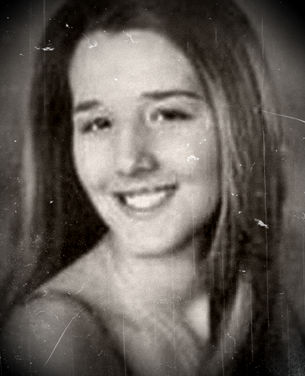
Kenzie Marie Houk was born on April 20th, 1982, in New Castle, Pennsylvania, the daughter of Jack and Deborah Burns Houk. By early 2009, she was living in a rented farmhouse on Wampum-New Galilee Road with her fiancé, Christopher Brown; her daughters, seven-year-old Jenessa and four-year-old Adalynn; and Christopher’s eleven-year-old son, Jordan.
Kenzie was a homemaker. She and Christopher were preparing to expand their blended family: Kenzie was in the final weeks of pregnancy with their first child together, a son they intended to name Christopher, after his father.
The impending arrival of the baby had prompted some changes inside the house. Christopher and Kenzie planned to move into Jordan’s upstairs bedroom because a small adjoining room had been converted into a nursery. Jordan’s belongings were being moved into the first-floor bedroom that the couple had previously shared.
That mundane rearrangement would later be transformed by prosecutors into part of a possible motive. They suggested Jordan resented the changes associated with the new baby. Years later, however, Pennsylvania’s Supreme Court would find that theory unsupported by the evidence. Testimony at the juvenile proceeding indicated that Jordan and Kenzie had a normal, affectionate relationship, and the high court characterized the supposed motive as speculative.
Friday, February 20th, 2009, began cold and snowy. Christopher Brown left for work at approximately six forty-five a.m. He later told investigators that snow was on the ground when he drove away.
Inside the house were Kenzie, Jordan, Jenessa and Adalynn. According to Jordan’s later account, he came downstairs from his bedroom to get dressed for school. Some of his clothing had already been moved into Kenzie’s first-floor bedroom, where she was still in bed. He retrieved his clothes, dressed in a bathroom, and then sat watching television with Jenessa. Adalynn remained asleep.
Jordan said he heard Kenzie using her cellphone and then heard her call to the children that they needed to leave or they would miss the bus. Jordan and Jenessa left the house at approximately eight fourteen a.m.
The school bus driver later testified that he saw them walking down the long driveway. When they noticed the bus, both children began running toward it, with Jordan moving somewhat faster than Jenessa. The driver saw nothing unusual in their behavior and did not see Jordan step off the driveway or throw anything away. Both children boarded the bus and went to Mohawk Elementary School. Adalynn, still only four years old, remained home with her mother.
Approximately forty-five minutes after the school bus departed, a six-man tree-service crew arrived to collect firewood cut on the property the previous day. The men parked near the front of the farmhouse and began working.
One worker noticed a screen door standing open. It closed and then opened again. This time a crying little girl appeared. Adalynn told the workers that her mother was dead.
The crew’s owner called 911 while trying to comfort the child without disturbing the scene. Pennsylvania State Police arrived at approximately ten thirteen a.m.
Inside the front bedroom, officers found Kenzie lying on her left side on the bed. There was extensive bleeding around her head and upper body. Initially, responders attempted emergency lifesaving measures, but it soon became clear that the young mother had suffered a gunshot wound. Neither Kenzie nor her unborn baby could be revived.
Forensic pathologist Dr. James Smith later determined that Kenzie had been killed by a single shotgun blast entering the back of her neck.
The wound traveled slightly upward and forward, consistent with Kenzie lying on her left side when she was shot. Soot, powder, and other characteristics of the injury indicated that the muzzle had been less than two inches from her body and possibly in contact with her skin.
Some of the pellets entered the cranial cavity and damaged areas of the brain controlling essential functions such as breathing and heartbeat. Kenzie died rapidly.
Her unborn son died because his mother’s circulation had stopped. Contemporary reports said the baby, later identified as Christopher Allen Houk-Brown, was approximately nineteen and a half inches long and weighed seven and a half pounds.
Kenzie was twenty-six years old.
Police began searching the farmhouse. The investigators found no obvious signs of forced entry. Significantly, however, the doors were unlocked.
In the downstairs bedroom where Kenzie was killed, the television was still on. Inside an armoire beneath it investigators found firearms and ammunition, including an open box containing sixteen unfired 20-gauge Federal shotgun shells.
Upstairs, in Jordan’s bedroom, officers discovered several long guns standing against a wall beneath a blanket. Among them was a Harrington & Richardson youth-model 20-gauge shotgun.
When investigators opened its breech, two troopers said they smelled burnt gunpowder and observed residue inside. Both believed the weapon had been fired recently, although neither was testifying as a forensic expert and neither could scientifically determine when the weapon had last been discharged.
The discovery immediately intensified the focus on Jordan. Police already knew that the killer had used a shotgun. Now there was a 20-gauge shotgun belonging to the eleven-year-old inside the house, and officers believed it smelled as though it had recently been fired.
But proving that Jordan’s gun had killed Kenzie would become much more complicated than it initially appeared.
At around noon on February 20th, Trooper Janice Wilson went to Mohawk Elementary School. Jordan was in the nurse’s office complaining of a stomachache and had fallen asleep. He had not yet been told that Kenzie was dead.
Asked who had been in the house that morning, he identified Kenzie, his two stepsisters, and himself. He also described seeing a large black pickup truck near the garage when he left for school.
At that stage, police apparently regarded the truck as potentially important. Jordan said he had not seen anyone standing outside it.
Later that night, after the shotgun had been discovered, Wilson questioned him again at his grandmother’s home. Before that interview, Christopher Brown told his son that Kenzie was dead. According to testimony later presented in court, Jordan began crying.
During the second interview, Jordan provided additional details about the black truck. He said he had seen someone wearing a white hat bending or ducking down inside it and that interior lights appeared to be on. Investigators considered the evolution of his account suspicious.
Wilson then asked about his firearms. Jordan acknowledged owning a 20-gauge shotgun but denied firing it that morning. He said he had recently used the weapon with his father.
At approximately three-thirty a.m. on February 21st, police arrested the eleven-year-old for murder.
The case against Jordan was circumstantial, but investigators believed several pieces of evidence fit together.
A state laboratory examined the clothes he had been wearing. Two particles scientifically identifiable as gunshot residue were found: one on his shirt and another on his jeans. Other particles containing one or two of the chemical components commonly associated with gunshot residue were also detected.
At first glance, that appeared highly incriminating. But the Commonwealth’s own expert explained that gunshot residue does not necessarily establish that the person wearing the clothing fired a weapon. It can also be deposited by being near another firearm when it is discharged or by contact with something already contaminated with residue. Such particles can remain on clothing for long periods.
There was another complication. Jordan had fired the same shotgun at an indoor turkey shoot less than a week earlier. His father testified that Jordan had worn the same winter coat later seized by police.
The expert also said that someone firing a weapon inside an enclosed house would generally be expected to accumulate substantial gunshot residue because the particles would have little airflow in which to disperse. Only two complete particles were identified on Jordan’s shirt and pants.
There was no blood on his jacket, shirt, jeans or sneakers. There was no blood on the shotgun, and there were no latent fingerprints recovered from the gun.
And investigators found no blood, skin or other biological material inside the barrel, on the barrel’s exterior, or on the weapon’s frame, even though the fatal blast had been fired with the muzzle extremely close to Kenzie’s body.
Another potentially important discovery came the morning after Kenzie’s death. Police searching outside found three spent shotgun shells on the property. Two were badly rusted and appeared old. A third, a 20-gauge Federal shell, was found approximately a hundred feet from the house near a fence running alongside the driveway. It appeared much less weathered.
A firearms examiner determined that this shell had been fired from the youth-model shotgun found in Jordan’s bedroom.
Prosecutors believed they had an explanation: Jordan had killed Kenzie, ejected the shell, carried it outside and discarded it while walking down the driveway to catch his school bus.
There were problems with that scenario, however. The family’s guns had regularly been fired around the property, providing an innocent explanation for spent ammunition outside. The supposedly fresh shell was discovered beneath frozen leaves that were themselves covered with ice and snow.
And the bus driver, who had watched Jordan and Jenessa approach the bus, testified that he never saw Jordan step away from the driveway or throw anything.
The Pennsylvania Supreme Court would eventually conclude that the evidence supported an equally reasonable possibility that the shell had been left there before the murder.
Police did not focus exclusively on Jordan during the first hours of the investigation. They also sought Kenzie’s former boyfriend, Adam Harvey.
The history between Harvey and Kenzie’s family gave investigators reason to locate him quickly. Kenzie and several members of her family had obtained a permanent Protection From Abuse order stemming from an incident in 2008. According to the court record, Harvey had allegedly threatened Kenzie’s family. Christopher Brown testified that he had heard threatening voicemail messages Harvey left for Kenzie and that she was afraid of him.
Harvey owned a black Ford F-150 pickup. He had also recently learned through paternity testing that he was not Adalynn’s biological father. The evening before the murder, Harvey encountered Kenzie’s parents at a nightclub while picking up food and was told to leave.
Police located him on the afternoon of February 20th. Harvey told officers he had spent the night in the basement of his parents’ home and denied leaving during the relevant period. A gunshot-residue test of his hands was negative. Investigators also noted snow remaining on the hood and roof of his truck and reasoned that a round trip to the Houk residence would likely have disturbed it. He was eliminated as a suspect.
Harvey later denied making threats against Kenzie and her family and denied knowing exactly where she was living. He was never charged in connection with her death.
Because of Pennsylvania’s homicide laws, Jordan was initially charged in adult court despite being only eleven. Had the case remained there and resulted in a first-degree murder conviction, the potential consequences were enormous.
His attorneys fought to transfer the prosecution into juvenile court. The first judge considering the question refused, in part because Jordan continued to deny killing Kenzie. The judge reasoned that a juvenile who would not accept responsibility might be difficult to rehabilitate.
An appellate court found a constitutional problem with that logic: requiring Jordan to acknowledge the killing as a condition of obtaining juvenile treatment effectively required him to incriminate himself. The ruling held that this violated his Fifth Amendment rights.
The matter was eventually assigned to Judge John Hodge, who transferred the case into juvenile court. By then, Jordan had spent years in custody while the legal fight unfolded.
Jordan’s juvenile adjudication hearing took place in April 2012; he was then fourteen. The prosecution argued that the circumstances formed a coherent chain: Jordan had access to the shotgun, knew how to shoot it, was in the home that morning, had gunshot residue on his clothing, and a shell fired from his gun was found near the driveway. The state also suggested he had been jealous of Kenzie’s unborn son and unhappy about changes within the household.
The defense argued that there was no reliable forensic evidence proving Jordan’s shotgun was the murder weapon and no physical evidence establishing that Jordan had fired the fatal shot.
On April 13th, 2012, Judge Hodge adjudicated Jordan delinquent of first-degree murder and homicide of an unborn child: the juvenile-court equivalent of a guilty finding. He was placed in state custody for treatment and could legally have remained under juvenile-court supervision until his twenty-first birthday.
Kenzie Houk’s family believed justice had been done. Jordan and his father maintained that an innocent child had been wrongly accused. The appeals continued.
One of the central issues was whether the prosecution’s circumstantial evidence really eliminated the possibility of another killer.
The original juvenile findings had emphasized a supposed absence of unexplained footprints or tire tracks around the farmhouse, reasoning that no outsider could have entered.
But an appellate court reviewing the evidence found that conclusion unsupported by the record. The evidence about tracks was inconsistent. More importantly, the house had several entrances and its doors were unlocked. There was a period of roughly forty-five minutes between the children’s departure for school and the tree crew’s arrival. There was therefore a window in which someone could conceivably have entered and left.
The appeals moved through Pennsylvania’s courts for years. Jordan was eventually released from custody in 2016 after approximately seven years in detention, although his delinquency adjudication remained in place.
Then the Pennsylvania Supreme Court agreed to review whether the evidence had ever been sufficient to find him responsible beyond a reasonable doubt.
On July 18th, 2018, Pennsylvania’s highest court issued its decision. The ruling dismantled several pillars of the prosecution’s case.
The pellets removed from Kenzie’s body were consistent with 20-gauge ammunition found in the house, but an expert could not identify them as having come specifically from Jordan’s shotgun.
The fact that the gun smelled as if it had recently been fired did not establish when it had been fired. Jordan had used it at a shooting event less than a week earlier.
The absence of blood or biological material on the weapon was particularly significant given the extremely close range of the fatal shot. Likewise, the gunshot-residue evidence did not establish that Jordan had fired a gun that morning.
The spent shell beside the driveway could have originated from earlier target shooting, and though there was no forced entry, there did not need to be, because the doors were unlocked.
Further, Jenessa, who had been in the house with Jordan throughout the relevant morning, initially told police nothing about hearing a shotgun blast or witnessing anything abnormal. The bus driver likewise saw nothing unusual when the two children boarded for school.
The Supreme Court also rejected the alleged jealousy motive, saying there was no evidence supporting the assertion that Jordan was alienated from Kenzie or resentful of the expected baby.
Ultimately, the justices found that the evidence was consistent with two reasonable possibilities: Jordan committed the killing as prosecutors alleged, or an unknown person entered the unlocked farmhouse after the children departed and killed Kenzie.
When the evidence reasonably supports guilt and innocence in equal measure, the court ruled, it cannot sustain a finding beyond a reasonable doubt.
Jordan’s delinquency adjudication was vacated, and he was discharged. Legally, the prosecution against him was over.
The ruling did little to resolve the emotional divide surrounding the case. Jordan Brown and his attorneys considered the decision an exoneration. Kenzie Houk’s parents did not.
Her father, Jack Houk, reacted angrily to the 2018 ruling, and her mother, Deborah, continued to say publicly in later years that she believed Jordan had killed her daughter. The family had raised Kenzie’s two daughters following her death and viewed the overturned adjudication not as proof of Jordan’s innocence but as a failure of the legal system.
Jordan later sued former Pennsylvania State Police investigators, accusing them of malicious prosecution and fabrication of evidence during the original investigation. That lawsuit brought the events of February 2009 back into a courtroom more than fifteen years after Kenzie’s death.
In December 2024, however, a federal jury found in favor of the troopers, concluding that they were not liable for malicious prosecution or fabrication of evidence. A federal judge subsequently rejected Jordan’s request to overturn that verdict or grant him a new civil trial on September 25th, 2025.
Jordan appealed. As of June 2026, that civil appeal was proceeding in the U.S. Court of Appeals for the Third Circuit. The civil litigation does not reinstate his juvenile adjudication and does not determine who killed Kenzie. It concerns whether the investigators violated Jordan’s constitutional rights while building the case against him.
Seventeen years after Kenzie Marie Houk was killed, the case occupies an unusual place in true-crime history. It was once presented as an almost incomprehensible crime committed by an eleven-year-old child: a boy supposedly retrieving his youth shotgun, shooting his pregnant future stepmother at close range and then calmly boarding a school bus.
For years, that was the official version of what happened. It no longer is. The evidence that appeared powerful in 2009—gunshot residue, a recently fired shotgun, a discarded shell and the absence of forced entry—proved far less conclusive under close appellate scrutiny. None placed Jordan Brown definitively behind the weapon that killed Kenzie.
Therefore, no standing conviction identifies Kenzie Houk’s killer, and as of this writing, the crime is officially unsolved.

