
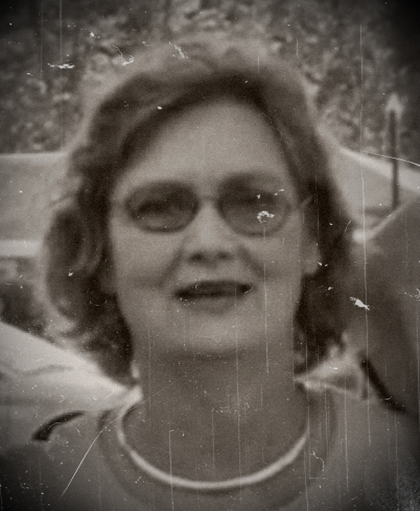
Connie Jane Ridgeway was born on July 4th, 1956. Her birthday, Independence Day, was particularly appropriate for a woman who loved patriotic decorations and collected items bearing the American flag.
She lived in Rogersville, a small community in Lauderdale County in northwestern Alabama, not far from the Tennessee River. Rogersville was the kind of town where neighbors recognized one another and where a familiar face at church, the grocery store, or a local apartment complex could become part of the fabric of everyday life.
Connie was the mother of two sons, Austin and Cameron Williams. Her relationship with her children was central to her life, and she had worked to instill in them the religious faith that remained important to her. The family attended Clements Baptist Church, where Connie made certain her boys participated in church activities and services as they grew up.
Connie was also creative. She enjoyed crafts and made small decorative angels from white felt, which she distributed to friends, relatives, and members of her congregation. They were simple gifts, but they reflected her affectionate nature and her desire to brighten other people’s lives.
By 2015, she was fifty-nine years old and living at Meadowlands Apartments in Rogersville. Many residents of the complex were elderly or lived on limited incomes. Some did not own vehicles, making ordinary tasks such as grocery shopping or attending medical appointments difficult.
Connie regularly stepped in to help. She drove neighbors to supermarkets and doctors’ appointments and sometimes transported them to larger cities such as Huntsville and Birmingham. These acts of kindness were not exceptional occasions for her. Her son Austin described a woman who approached strangers with warmth and treated the people around her with genuine concern.
Her kindness also made the circumstances of her murder especially bewildering. She was not a wealthy woman living an extravagant lifestyle. She was not publicly associated with criminal activity or violent disputes. The people who remembered her described a friendly, generous individual who seemed more likely to help a stranger than argue with one.
Friday, October 23rd, 2015, began as an ordinary autumn day in northwestern Alabama. Connie was living in her apartment at Meadowlands Apartments, a residential complex near Lauderdale County High School.
What happened inside her home that day has never been publicly reconstructed in full. At approximately five thirty p.m., authorities were alerted after a neighbor discovered Connie inside her apartment. Police responding to the scene found evidence of a violent attack. Connie had suffered fatal stab wounds, and her body was discovered on the living room floor.
The Lauderdale County coroner pronounced her dead at the scene. Her remains were subsequently transported to the Alabama Department of Forensic Sciences laboratory in Huntsville for an autopsy.
The initial investigation involved Rogersville police, with the Alabama State Bureau of Investigation assuming a leading role. Lauderdale County authorities also assisted.
Among the most pressing questions were how the attacker had entered her apartment, whether Connie knew the person responsible, and whether the killing had been planned.
In November 2015, Connie’s relatives formally requested additional involvement from the sheriff’s department. Lauderdale County Sheriff Rick Singleton announced that his investigators would assist state authorities in searching for the person or people responsible.
One of the challenges was the apparent absence of an obvious motive. Connie’s family and friends knew her as a generous woman who maintained strong relationships with her neighbors and church community. Public reports from the early investigation did not establish that she had been involved in a personal confrontation or had received threats immediately before her death.
That didn’t mean investigators could eliminate those possibilities. It meant that, without additional evidence, there was no clear narrative explaining why Connie had been targeted.
As weeks turned into months, authorities continued examining potential leads, but no arrest followed. The first anniversary of Connie’s murder arrived in October 2016 without a resolution. Then came the second anniversary, the third, and the fourth.
In November 2019, Alabama Governor Kay Ivey issued a proclamation offering a $5,000 reward for information leading to the arrest and conviction of those responsible for Connie’s murder. The reward represented another effort to encourage someone with knowledge of the crime to come forward. Still, the case remained unsolved.
Then, unexpectedly, a development emerged from inside the Alabama prison system. By June 2020, Casey Cole White was serving a seventy-five-year prison sentence for a series of violent crimes committed in December 2015. Those offenses, which occurred less than two months after Connie’s murder, included attempted murder, kidnapping, robbery, burglary, and other crimes associated with a violent spree in Limestone County, Alabama. In February 2019, White had been convicted of nine offenses. He received his lengthy prison sentence that April.
While incarcerated at the William E. Donaldson Correctional Facility, White sent a letter to Lieutenant Brad Potts of the Lauderdale County Sheriff’s Office. According to District Attorney Chris Connolly, the letter prompted Potts to visit the prison and interview White. During that interview, White confessed to killing Connie Ridgeway.
This was an extraordinary development. For almost five years, investigators had been unable to identify a perpetrator publicly. Now a convicted violent offender was claiming responsibility for the crime.
The most compelling aspect of White’s statement, according to prosecutors, was that he supplied details consistent with evidence investigators had deliberately withheld from the public. Connolly stated that White’s account contained information about the crime scene that had not appeared in news reports. This suggested that White possessed knowledge warranting serious investigation.
But the confession also introduced an entirely new possibility. White claimed that he had not murdered Connie because of a personal dispute. He alleged that he had been paid to kill her.
The allegation that Connie Ridgeway had been murdered for money changed the direction of the investigation. If Casey White’s confession was accurate, the killing might have been carried out on behalf of someone with a specific reason to want Connie dead. But who would have wanted to murder a woman whose life revolved around her family, church, and neighbors?
Investigators began examining a potentially significant detail from Connie’s life. At the time of her death, Connie had reportedly been involved as a witness in an unrelated grand jury proceeding concerning the financial exploitation of an elderly person. This fact attracted investigators’ attention because it raised the possibility that Connie possessed information someone wanted to suppress.
In September 2020, Lauderdale County District Attorney Chris Connolly confirmed that investigators were examining the possible connection. However, there were important limitations to this theory. Authorities had not publicly established that the financial exploitation investigation was connected to Connie’s death. They had not identified a person who allegedly hired White, nor had they demonstrated publicly that money changed hands. The murder-for-hire allegation originated with White himself.
On September 1st, 2020, Lauderdale County prosecutors publicly announced that a grand jury had indicted Casey Cole White on two counts of capital murder in connection with Connie’s death. One count alleged murder committed during a first-degree burglary. The other alleged murder committed for financial gain. White was thirty-seven years old when the indictment was announced.
The case was far from straightforward. White subsequently recanted his confession and entered a not-guilty plea. His reversal meant prosecutors would have to prove their allegations without relying on an uncontested admission.
The circumstances surrounding his original confession, including his claim that he had been hired to kill Connie, would likely have become important subjects of scrutiny had the case proceeded to trial. Whether investigators possessed sufficient independent evidence to secure a conviction remained an open question.
The trial would never reach that stage. On April 29th, 2022, Casey White disappeared from the Lauderdale County Detention Center in Florence, Alabama. He had not escaped by overpowering a guard or breaking through the jail’s security systems. Instead, he had walked out of the building accompanied by a senior corrections officer. Her name was Vicky White. Despite their shared surname, the two were not related.
Vicky was a longtime employee of the Lauderdale County corrections system, with more than twenty-five years of service. She was highly regarded by many colleagues and occupied a position of responsibility within the jail.
On the morning of the escape, she told other employees that she was transporting Casey White for a mental health evaluation. There was no such scheduled appointment. Investigators subsequently determined that she had assisted White in a carefully planned escape.
As authorities examined the circumstances, they uncovered evidence suggesting that Vicky and Casey had developed a romantic relationship while he was incarcerated. Recordings, telephone records, and other evidence revealed extensive communication between the two. Authorities eventually identified approximately 1,100 telephone calls associated with their relationship. Vicky had also made preparations before the escape, including purchasing items and arranging transportation.
The disappearance triggered an enormous manhunt involving local, state, and federal law enforcement agencies. For eleven days, the fugitives remained at large. The story became national news. Much of the coverage focused on the seemingly improbable relationship between a respected jail official and a violent prisoner. Journalists examined Vicky’s personal life, the security failures that allowed the escape, and the preparations the couple had made.
On May 9th, 2022, investigators located the fugitives in Evansville, Indiana. A vehicle pursuit followed. Law enforcement officers forced their vehicle off the road, bringing the escape to an end. Casey White surrendered. Vicky White suffered a self-inflicted gunshot wound and died from her injuries.
Even after his capture, Casey White remained a complicated figure in the Connie Ridgeway investigation. His original confession had been important enough for prosecutors to secure a capital murder indictment. But he had subsequently withdrawn that confession.
That reversal created serious questions about what White actually knew and why he had initially claimed responsibility. Had he confessed truthfully and later changed his account? Had he fabricated the confession for reasons of his own? Was some portion of his original statement accurate while other details were misleading?
Prosecutors had maintained that White supplied details consistent with unreleased crime-scene evidence. However, those details were not comprehensively presented and tested before a jury. It is therefore difficult for outside observers to independently evaluate the strength of the purported corroboration.
In the meantime, White faced punishment for his escape from custody. In May 2023, he pleaded guilty to first-degree escape as part of an agreement that resulted in the dismissal of a separate felony murder charge connected to Vicky White’s death. The following month, he received a life sentence for the escape. He was also still serving the seventy-five-year sentence imposed for his earlier violent crimes.
Under the sentencing arrangements reported at the time, White would not be eligible for parole consideration until 2081, when he would be approximately ninety-eight years old.
In July 2023, just weeks before Casey White was expected to stand trial for Connie Ridgeway’s murder, Lauderdale County District Attorney Chris Connolly announced that prosecutors were suspending the case. The decision was made through a legal procedure allowing the prosecution to be discontinued while preserving the possibility of reinstating charges. The state cited White’s existing prison sentences and the considerable resources that would be required to conduct a capital murder trial.
But there was another important consideration. Investigators were continuing to examine whether other individuals might have been involved in Connie’s death.
Connolly stated that the decision had been discussed with Connie’s two adult sons, Austin and Cameron, as well as investigators working on the case. Both sons supported suspending the prosecution at that time.
For the family, the decision presented a difficult reality. Even a conviction would not necessarily change White’s immediate circumstances. He was already incarcerated under sentences that made his eventual release extremely unlikely. A trial could consume substantial resources while leaving unanswered the questions about a possible accomplice or person who had arranged the killing.
At the same time, suspending the case meant that White would not be convicted or acquitted of Connie’s murder. Casey White has never been convicted of murdering Connie Ridgeway. His original confession, subsequent recantation, and the decision to suspend prosecution leave his involvement unresolved as a matter of law.
The decision also meant that the search for Connie’s killer was not over. Investigators retained the ability to pursue additional evidence, examine possible accomplices, and reconsider the prosecution if future developments warranted it.
On October 21st, 2026, the Alabama Law Enforcement Agency issued a public appeal as the eleventh anniversary of Connie’s murder approached. The agency confirmed that the investigation remained open and that its State Bureau of Investigation continued seeking information.
Authorities also announced a dedicated online page through which members of the public could submit anonymous tips. A $5,000 reward was offered for information leading to the resolution of the investigation.
The appeal also made something unmistakably clear. Despite the confession, indictment, escape, and years of legal proceedings involving Casey White, Connie Ridgeway’s murder was still officially unsolved.

